


Share Dr. Arias Shah:

A practical teaching case for moving from description to a revisable formulation.
A systemic hypothesis should help you decide what to explore next. It offers a provisional explanation of how a presenting concern relates to interactions, meanings, and context. Simply adding family members to a symptom description does not yet explain the pattern.
For MFT interns, the challenge is often moving from a detailed case summary to a formulation that guides clinical attention. The steps below offer a teaching structure. They do not replace comprehensive assessment, your program’s requirements, or consultation with your supervisor.
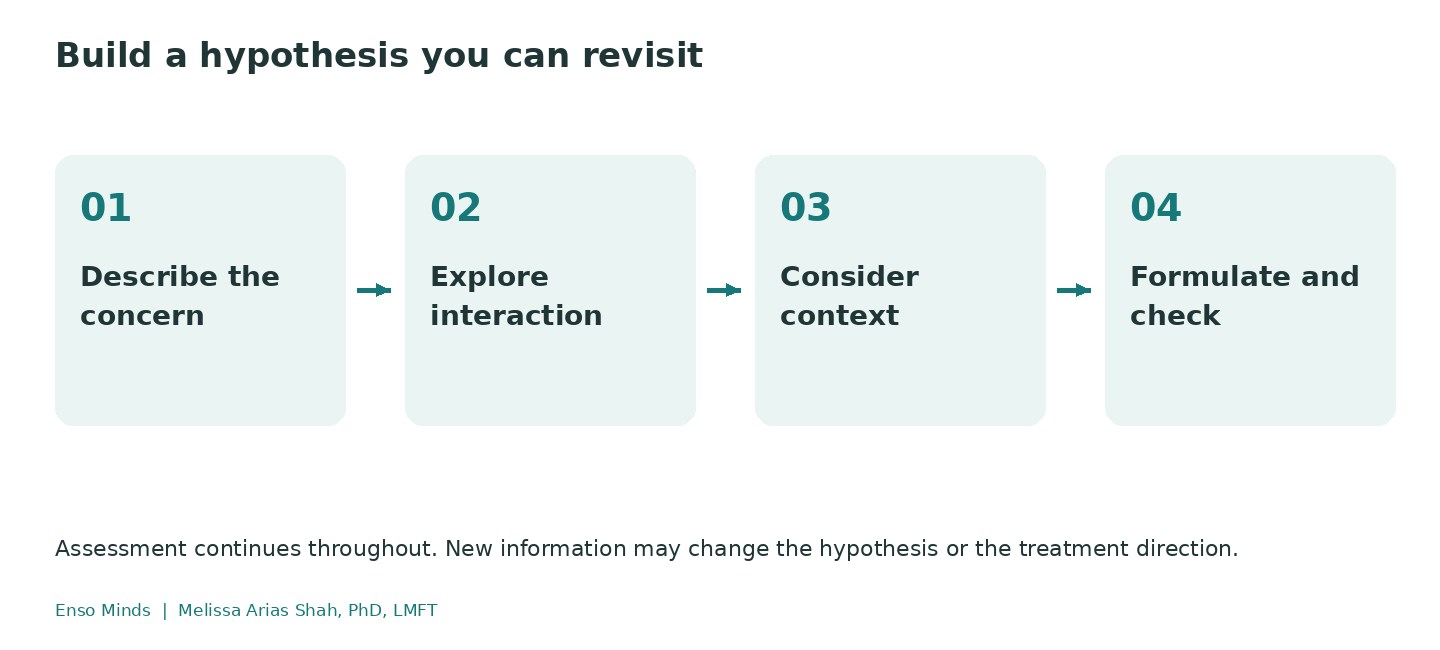
Original Enso Minds teaching graphic. Assessment continues throughout. New information may change the hypothesis or the treatment direction.
Start with what you know and how you know it
Separate the presenting concern, observations, participant reports, and your interpretation. “The adolescent is defiant” blends description with judgment. “The caregiver reports that homework discussions often end when the adolescent leaves the table” provides a sequence you can explore.
Ask each participant what they hope will change, what they think contributes to the difficulty, and when it is less intense. Assess relevant safety concerns, symptoms, development, health, and functioning. A relational formulation complements these responsibilities; it does not replace them.
Sheinberg and Brewster (2014) describe relational hypotheses as provisional conceptualizations that connect presenting problems with relational context. The formulation remains open to revision as the conversation develops.
Follow one interaction closely
Consider this fictional family. Jordan, age 14, and caregivers Ana and Marcus seek help for homework conflict. Ana reports repeatedly reminding Jordan to begin. Jordan says the reminders feel like criticism and responds by arguing. Marcus sometimes overrides Ana to stop the disagreement. Ana feels unsupported and increases her monitoring the following evening. Jordan completes work more readily when an adult asks about confusion with the assignment before giving instructions.
These are illustrative reports, not facts from an actual client or evidence of a diagnosis. We still need to assess learning needs, school experiences, safety, developmental expectations, and each participant’s account.
To elaborate the sequence, ask: What happens before the reminder? What does Jordan do next? How does Marcus decide when to intervene? What happens between the caregivers afterward? Questions about differences are equally useful: What changes on evenings when homework goes more smoothly?
Distinguish circular causality from a hypothesis
Circular causality describes reciprocal influence: a response becomes part of the context for the next response. A systemic hypothesis proposes how particular interactions may be connected with a concern in this family, at this time, through a stated theoretical lens.
For example, “Ana reminds, Jordan argues, and Marcus intervenes” identifies a sequence. A hypothesis goes further by tentatively describing how caregiver coordination, interpretations of the reminders, or other relational processes may help maintain the sequence. Do not infer that Jordan’s distress exists to serve a family function simply because an interaction repeats.
Keep the direction of influence open. Homework difficulty may increase conflict, and conflict may make homework participation harder. Neither possibility rules out a learning difference, exhaustion, or another explanation.
Add context before assigning meaning
Explore how work schedules, language, racism, financial stress, migration experiences, disability, and school expectations shape the family’s options. Ask what involvement in homework means to each caregiver. A behavior described as intrusive by one person may be understood as care or responsibility by another.
Also ask what your own social location makes easier to notice or overlook. Avoid treating closeness as evidence of enmeshment or disagreement as proof of a weak parental relationship. Determine whether the interpretation fits the family’s experiences and the relevant model.
Choose a theoretical lens explicitly
A Structural formulation attends to family organization, subsystems, and boundaries (Minuchin, 1974). A Narrative formulation explores problem-saturated meanings, externalizing descriptions, and openings for preferred accounts of identity and relationship (White, 2007). These lenses can guide different questions about the same case.
The following examples are original teaching applications, not quotations or validated assessments. A Structural hypothesis might be: “When homework becomes tense, inconsistent caregiver responses may leave expectations unclear and reinforce repeated monitoring and protest. Exploring caregiver coordination and the ways Jordan can express learning needs may reveal opportunities for a more workable interaction.”
A Narrative formulation might be: “Descriptions of Jordan as irresponsible and Ana as controlling may be narrowing how family members understand homework conflict. Exploring the influence of these descriptions, along with times the family has responded with curiosity and cooperation, may support preferred ways of relating.”
In Narrative practice, offer such ideas tentatively and invite the family’s language. Do not turn a therapist’s systemic explanation into an authoritative story that overrides participants’ knowledge.
Check the hypothesis with the family
Try a question that makes disagreement possible: “I wonder whether our current way of handling homework leaves each of you feeling less heard. What fits about that, and what am I missing?” The family’s response can sharpen, complicate, or reject your interpretation.
Record evidence that challenges the hypothesis. If conflict persists despite coordinated caregiver responses, the original explanation may be incomplete. If Jordan reports bullying or difficulty reading instructions, assessment and intervention priorities may change.
For supervision, bring a brief hypothesis, the observations supporting it, at least one competing explanation, and the next question you intend to ask. This gives your supervisor something specific to examine with you.
Use the hypothesis to guide the next session
Before finalizing your formulation, ask whether it identifies a relational process, includes relevant context and strengths, fits your stated model, and suggests a next step. Be cautious with confident language such as “caused by” when your information supports only a possibility.
The companion article, “From Systemic Hypothesis to Treatment Plan,” follows this fictional case into goals, interventions, and progress review. To explore clinical supervision with Enso Minds, contact Enso Minds (https://ensominds.com/contact/).
This educational example is not a complete assessment or treatment plan. Apply it within your competence and supervision requirements.
References
Minuchin, S. (1974). Families and family therapy. Harvard University Press. https://doi.org/10.4159/9780674041127
Sheinberg, M., & Brewster, M. K. (2014). Thinking and working relationally: Interviewing and constructing hypotheses to create compassionate understanding. Family Process, 53(4), 618–639. https://doi.org/10.1111/famp.12081
White, M. (2007). Maps of narrative practice. W. W. Norton & Company.
About the author

Melissa Arias Shah, PhD, LMFT is a licensed marriage and family therapist, educator, clinical supervisor, and founder of Enso Minds. Her work emphasizes relationships, strengths, culture, and intentional change. Services are available in English and Spanish. Contact Enso Minds to discuss service fit and availability.
Explore Clinical SupervisionShare Dr. Arias Shah:
