


Share Dr. Arias Shah:

Connect clinical reasoning with goals, interventions, and evidence of progress.
A treatment plan becomes useful when you can explain why an intervention fits the change the client wants. “Use communication skills” gives you little direction unless you identify what will change between people, how you will support that change, and what progress would look like.
This article continues the fictional homework-conflict case from “How to Write a Systemic Hypothesis.” Jordan, age 14, and caregivers Ana and Marcus describe repeated reminders, protest, and inconsistent caregiver responses. The family also reports more cooperation when adults first ask about difficulty with the work. All examples and numerical targets below are teaching illustrations to adapt collaboratively.
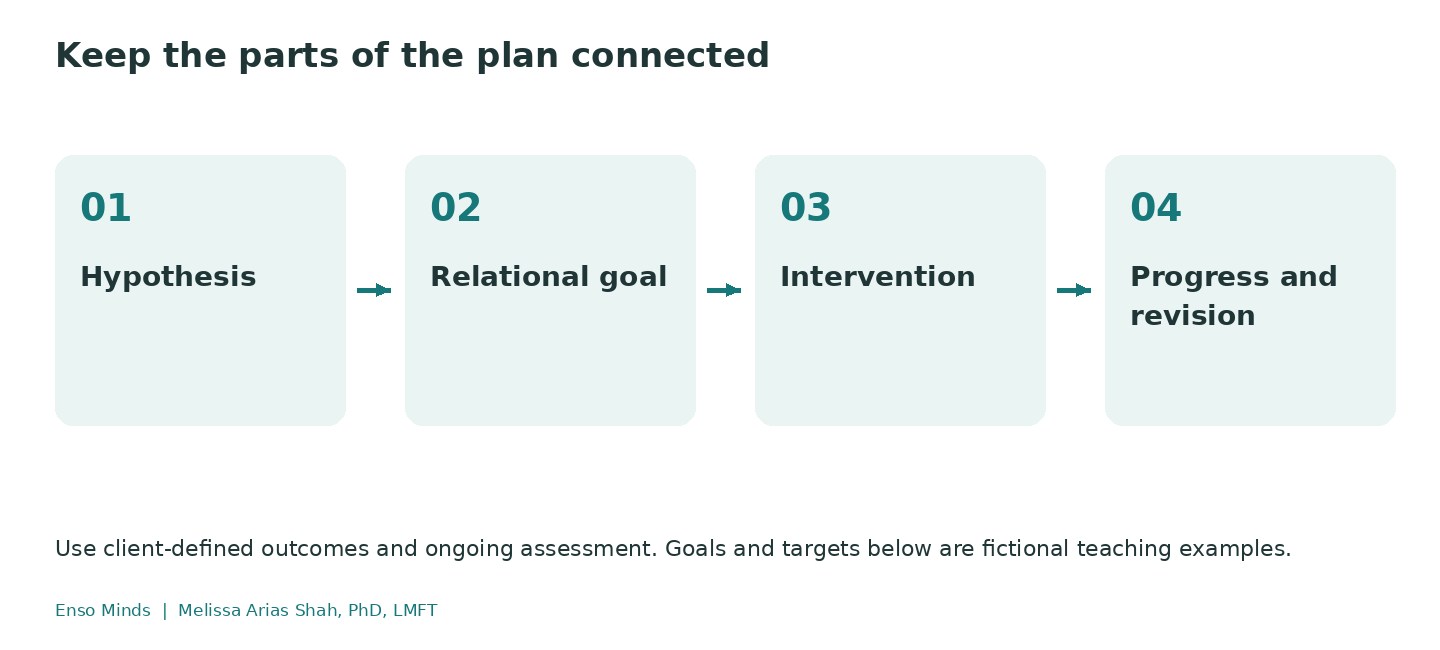
Original Enso Minds teaching graphic. Use client-defined outcomes and ongoing assessment. Goals and targets below are fictional teaching examples.
Agree on the concern and desired change
Begin with the family’s priorities. Jordan wants fewer arguments and a chance to explain confusion. Ana wants shared responsibility for the routine. Marcus wants a way to help without escalating conflict. Clarify whether these outcomes are compatible and where more discussion is needed.
Continue assessment of learning needs, development, safety, health, and school context. A plan to change interaction will be incomplete if a child cannot access the assignment or is responding to an unsafe environment. Coordinate with other professionals when appropriate, with the necessary consent and attention to confidentiality.
Relational hypotheses can provide continuity across sessions while remaining provisional (Sheinberg & Brewster, 2014). Their value here is to guide questions and choices, rather than prescribe a fixed sequence for every family.
Separate goals from interventions and outcomes
A goal describes the change the family seeks. An intervention describes what the therapist does to support it. An outcome indicator describes information that will help the family and therapist judge progress.
For this family, “Caregivers will coordinate homework expectations while inviting Jordan’s input” is a relational goal. Facilitating a discussion in session is an intervention. Family reports and observed examples of coordinated responses are possible indicators. The intervention alone is not evidence that the goal has been reached.
Choose feasible ways to monitor change. Ask whether a proposed rating or log helps the family or becomes another source of monitoring and conflict. A goal should be specific enough to guide work without imposing a measurement routine that undermines the desired relationship.
A Structural treatment direction
Structural family therapy offers concepts for examining organization, subsystems, and boundaries (Minuchin, 1974). In this teaching application, the hypothesis is that inconsistent caregiver responses may contribute to an unclear routine that reinforces monitoring and protest. That possibility must be checked against the family’s experiences.
In the beginning phase, join with all participants and explore how they understand the concern. Observe interaction without assuming that one person’s account is the whole story. A brief enactment might invite the family to discuss a recent homework decision while you observe who speaks, who responds, and how disagreement is managed.
During the working phase, support caregivers in discussing expectations directly with one another, while making room for Jordan’s developmentally appropriate participation. Coach a new interaction in session: the caregivers agree on an initial response, ask Jordan about barriers, and negotiate a feasible next step. Adjust boundary work to culture, caregiving needs, and safety.
An illustrative goal is: “Over the next four weeks, the caregivers will use a shared homework plan on three school evenings per week, invite Jordan to identify barriers, and discuss adult disagreements directly.” The family might track whether conflict is less intense and whether Jordan experiences greater opportunity to be heard. These are negotiated targets, not model requirements.
A Narrative treatment direction
Narrative practice offers ways to explore the influence of problems and develop preferred accounts of identity and relationship (White, 2007). Here, the focus shifts toward descriptions such as irresponsible, controlling, or uncaring that may restrict how family members respond to one another.
In the beginning phase, ask what the family would call the problem and whether separating it from any one person fits their experience. If they choose “the Homework Battle,” explore when it appears and what it persuades each person to believe about themselves and others. Externalizing language should be meaningful to the family, rather than an exercise the therapist insists on using.
During the working phase, investigate exceptions in detail. Ask about an evening when curiosity interrupted the conflict. What did each person do? What did that show about the relationships they value? Invite the family to give those actions meaning and consider how they might carry that preferred account into another evening.
An illustrative goal is: “Across the next four sessions, the family will identify and elaborate two examples of responding to homework pressure in ways they associate with respect and cooperation, then choose a response to practice.” An optional written record might preserve their own language. Review whether they experience more choice and less blame, alongside changes in daily conflict.
These descriptions compare two possible treatment directions. They are not instructions to combine both models without a clear rationale. Discuss your chosen framework and any integration with your supervisor.
Review the plan throughout therapy
Ask each participant what is improving, what remains difficult, and whether the goals still fit. Look for differences between accounts: caregivers may report less arguing while Jordan reports feeling less able to speak. That discrepancy deserves exploration before concluding that the interaction has improved.
When progress stalls, reconsider the hypothesis, the fit of the intervention, practical barriers, and the therapeutic relationship. Avoid treating lack of progress as evidence that the family is resistant. Revise the plan when new information suggests a different direction.
Plan for ending and future difficulties
Discuss discharge in relation to collaboratively defined outcomes, functioning, safety, and the family’s ability to sustain helpful responses. Invite participants to describe what they would do if homework conflict increased during exams or a schedule change. Identify when to return for support or seek another service.
For supervision, be ready to explain the link between your hypothesis, goal, intervention, and progress information. If one part does not connect, that is a useful place to slow down and refine your reasoning. To discuss clinical supervision with Enso Minds, contact Enso Minds (https://ensominds.com/contact/).
This article provides educational illustrations. It does not establish a required session count, replace supervision, or supply a complete treatment plan for an actual client.
References
Minuchin, S. (1974). Families and family therapy. Harvard University Press. https://doi.org/10.4159/9780674041127
Sheinberg, M., & Brewster, M. K. (2014). Thinking and working relationally: Interviewing and constructing hypotheses to create compassionate understanding. Family Process, 53(4), 618–639. https://doi.org/10.1111/famp.12081
White, M. (2007). Maps of narrative practice. W. W. Norton & Company.
About the author

Melissa Arias Shah, PhD, LMFT is a licensed marriage and family therapist, educator, clinical supervisor, and founder of Enso Minds. Her work emphasizes relationships, strengths, culture, and intentional change. Services are available in English and Spanish. Contact Enso Minds to discuss service fit and availability.
Explore Clinical SupervisionShare Dr. Arias Shah:
