


Share Dr. Arias Shah:

Help your child feel understood while building a plan for everyday participation.
“Are you sure nothing bad will happen?” You answer as carefully as you can. A few minutes later, your child asks again. You offer another explanation, cancel an activity, or stay close a little longer. Everyone feels some relief, but the question returns.
Parents often respond this way because they care deeply about their child’s distress. When reassurance becomes a repeated part of the day, it can help to look at the larger pattern and seek guidance about what support your child needs.
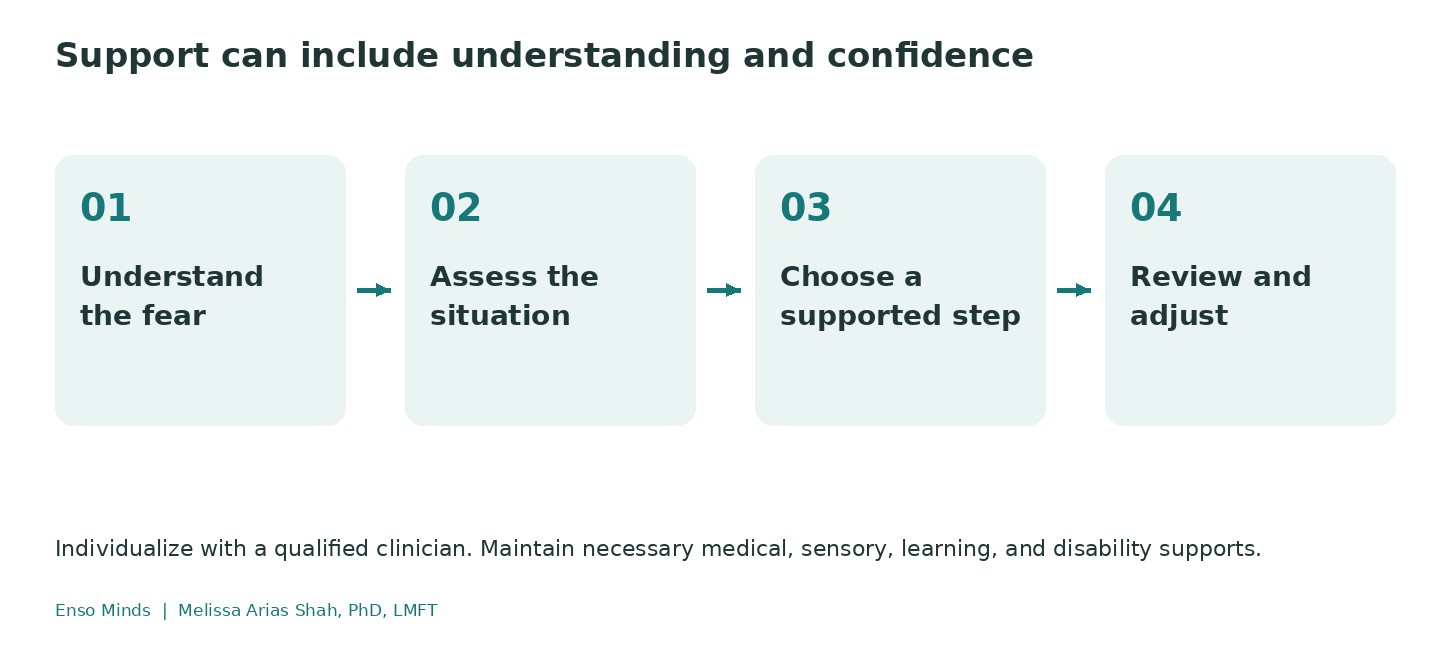
Original Enso Minds teaching graphic. Individualize with a qualified clinician. Maintain necessary medical, sensory, learning, and disability supports.
Understand what happens around the worry
Notice when reassurance is requested, what you do, and what happens afterward. Does the answer help your child return to an activity? Does it lead to more questions? Have family routines become increasingly organized around avoiding a feared situation?
Family accommodation is a research term for changes family members make in response to anxiety, such as repeatedly providing reassurance or helping someone avoid a feared activity. In a randomized trial, a structured parent-based treatment called Supportive Parenting for Anxious Childhood Emotions, or SPACE, was noninferior to child-focused cognitive behavioral therapy for anxiety outcomes in the studied sample (Lebowitz et al., 2020). This supports parent involvement as a treatment option, rather than a conclusion that parents caused the anxiety.
The study involved children ages 7–14, and most participants were White. Its results should not be treated as a guarantee for every child, age group, or family. This article is also not a SPACE treatment protocol.
Validate what your child feels
Validation means showing that you recognize the experience. You might say, “I can see how worried you feel about going in,” or “That thought sounds really upsetting.” You can acknowledge distress without agreeing that the feared outcome is certain.
Try pairing understanding with confidence in a supported plan: “I know this feels hard. We will use the plan we made with your therapist.” The wording should fit your child’s age, communication style, and needs. Some children may respond better to brief language, pictures, or a predictable written plan than a long conversation.
You do not have to sound perfectly calm or find a phrase that immediately removes the fear. A useful aim is to help your child know you are listening and that the family can seek help together.
Separate anxiety from unmet needs and real danger
Avoidance can have more than one explanation. A child who resists school might be facing bullying, learning difficulties, sensory overload, discrimination, or an unsafe interaction. Physical discomfort may need medical evaluation. Ask what is happening before deciding that anxiety explains the behavior.
Necessary disability accommodations, sensory supports, communication aids, and medical care serve important functions. Do not remove them simply because they reduce distress. The relevant question is what a particular support does for this child in this setting.
A clinician can help distinguish support that enables access and participation from a response that may be reinforcing anxiety-driven avoidance. Sometimes both functions are present, and the plan needs to account for both.
Make changes collaboratively and gradually
If repeated reassurance or avoidance is interfering with daily life, seek an individualized assessment before making major changes. Abruptly withdrawing support or forcing a frightening situation can damage trust and miss an important underlying problem.
For a fictional example, imagine a child who repeatedly asks a caregiver to check a backpack before leaving for school. After assessment, a therapist and family might develop a shared checking routine, a visual reminder, and a plan for responding to repeated requests. The specific steps would depend on the child’s needs, what the checking means, and whether other concerns are present.
The family can review what happened without framing a hard morning as failure. Was the step too large? Was the instruction unclear? Was there an unexpected stressor? A plan should provide information that helps the next attempt.
Consider the whole household
Anxiety can affect siblings, caregiver sleep, work schedules, and relationships. Family therapy’s attention to patterns and responsibilities provides a useful lens for considering that wider context (Minuchin, 1974). You can ask who is carrying most of the response to worry and what practical help the household needs.
Caregivers may also disagree. One person may provide more reassurance while another urges the child to push through. A shared plan can reduce confusing responses and create room to discuss each caregiver’s concerns. Avoid asking the child to choose which adult is right.
When to seek professional support
Contact a qualified clinician when worry disrupts school attendance, sleep, eating, friendships, or family life, or when routines are becoming increasingly restricted. New or concerning physical symptoms also warrant medical attention. Assessment can guide whether child-focused treatment, parent-focused work, family involvement, or another service is appropriate.
Before an appointment, jot down a few examples of the worry, your response, and its effect on the day. Bring questions about your child’s strengths as well as the difficulties. The goal is a fuller understanding of what helps your child participate in life with appropriate support.
To discuss family therapy and whether Enso Minds is a fit for your needs, contact Enso Minds (https://ensominds.com/contact/). This article offers general education and does not replace medical evaluation or an individualized treatment plan.
References
Lebowitz, E. R., Marin, C., Martino, A., Shimshoni, Y., & Silverman, W. K. (2020). Parent-based treatment as efficacious as cognitive-behavioral therapy for childhood anxiety: A randomized noninferiority study of Supportive Parenting for Anxious Childhood Emotions. Journal of the American Academy of Child & Adolescent Psychiatry, 59(3), 362–372. https://doi.org/10.1016/j.jaac.2019.02.014
Minuchin, S. (1974). Families and family therapy. Harvard University Press. https://doi.org/10.4159/9780674041127
About the author

Melissa Arias Shah, PhD, LMFT is a licensed marriage and family therapist, educator, clinical supervisor, and founder of Enso Minds. Her work emphasizes relationships, strengths, culture, and intentional change. Services are available in English and Spanish. Contact Enso Minds to discuss service fit and availability.
Explore Family TherapyShare Dr. Arias Shah:
