


Share Dr. Arias Shah:

Communicate what you can offer while respecting your needs and relationships.
You want to be available to your family. You also need rest, privacy, and time for the responsibilities already on your plate. When someone asks for more than you can offer, saying no may bring guilt before the conversation has even begun.
A boundary helps clarify what you can participate in and what you will do when a situation exceeds your limits. It can make your availability more honest. It cannot guarantee that someone else will agree, understand, or respond warmly.
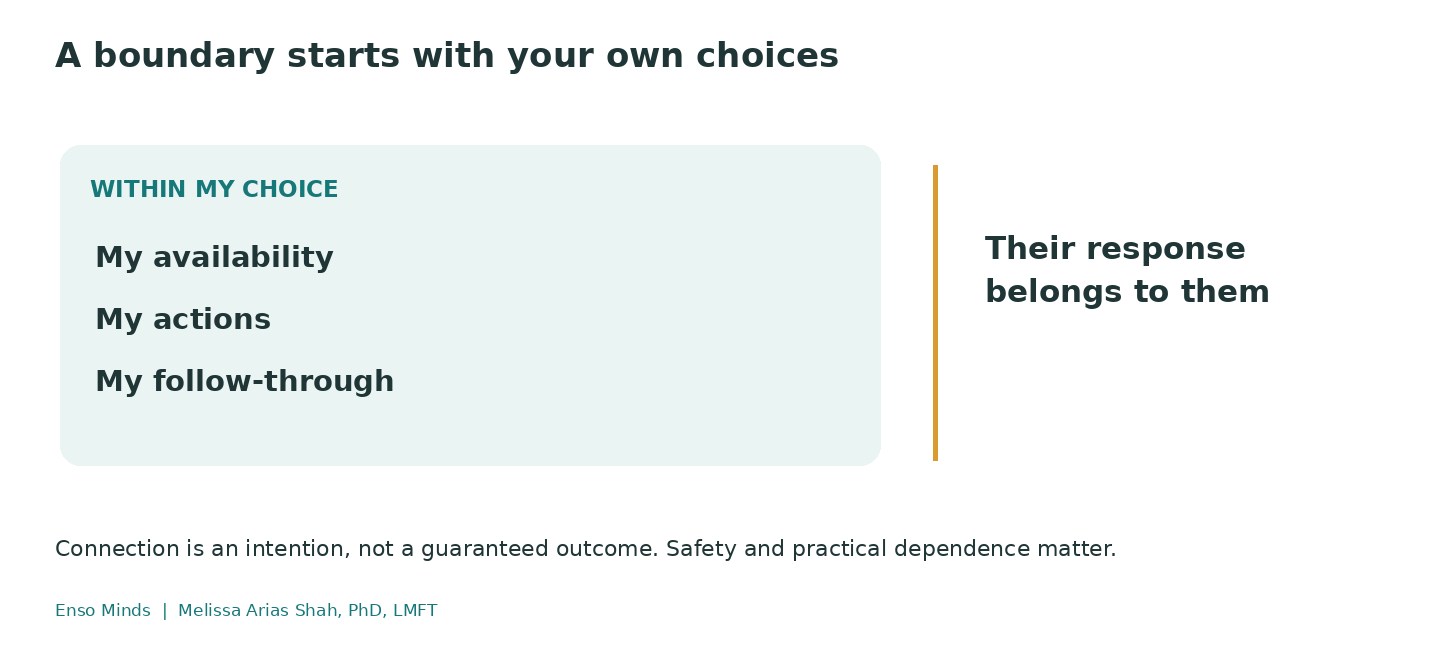
Original Enso Minds teaching graphic. Connection is an intention, not a guaranteed outcome. Safety and practical dependence matter.
Begin with what is yours to decide
A request asks someone to do something: “Please call before visiting.” A boundary describes your participation: “I can welcome visitors when we have arranged a time. If you arrive unexpectedly, I may not be able to invite you in.” The distinction matters because you can communicate your limit and make choices about your response, even when you cannot control someone’s behavior.
Family therapy has long examined how families organize closeness, privacy, and responsibilities (Minuchin, 1974). In everyday life, this can mean deciding who participates in a decision, what information you share, or how much caregiving you can realistically provide.
Boundaries can be flexible. You might choose to help during a genuine emergency while remaining unavailable for routine late-night calls. Flexibility works best when it reflects a considered choice rather than a promise you cannot sustain.
Name the limit before choosing the words
Suppose a relative expects you to answer every evening. Before explaining your boundary, decide what you can actually offer. Is it a weekly call, a brief text, or a conversation at a different time? A vague promise to “try harder” may leave both of you frustrated.
Try language that includes care and a specific limit: “I want to stay in touch. Evenings are when I help the children and prepare for the next day. I can call on Sunday afternoon.” You do not have to give a detailed defense of every responsibility for your time to matter.
When a conversation becomes insulting, you might say, “I want to hear your concern. If the name-calling continues, I will end this call and try again another day.” Choose follow-through that is realistic and safe for you. A boundary loses clarity when it depends on a consequence you do not intend to carry out.
Understand the guilt without letting it make every decision
You may have learned that being a good daughter, son, partner, or sibling means being available whenever someone needs you. A different response can feel disloyal even when it is reasonable.
Bowen’s concept of differentiation offers one lens for considering how to hold a personal position while remaining in relationship (Bowen, 1978). The Bowen Center also describes the capacity to act from thoughtfully held principles when relationships become emotionally pressured (The Bowen Center for the Study of the Family, n.d.). These are theoretical ideas, not a test of whether you are a good family member.
When guilt appears, ask what it is telling you. Have you broken an agreement that needs repair? Are you worried about disappointing someone? Are you carrying a responsibility that could be shared? Each answer suggests a different next step. The feeling deserves attention, but it does not have to decide the answer by itself.
Let culture and circumstances shape the conversation
Family closeness has many meanings. Shared homes, financial support, multigenerational caregiving, and regular contact can express connection and responsibility. They should not automatically be treated as signs of unhealthy dependence.
Consider the values you want to preserve. You might say, “Caring for our family matters to me. I can take Mom to appointments on Tuesdays. We need another plan for the other days.” This makes your contribution visible while opening a conversation about resources and shared responsibility.
If you rely on someone for housing, finances, transportation, or immigration-related support, the consequences of setting a limit may be substantial. A gradual plan, additional resources, or professional support may be more workable than an immediate confrontation. Advice that ignores those realities can create more pressure.
Expect adjustment without promising reconciliation
Someone may ask questions, negotiate, or feel disappointed. You can listen and still decide that your limit fits your needs. Sometimes a clarification helps: “I am not available tonight. I can talk tomorrow at lunch.” Repeating the same message calmly may be more useful than finding a more persuasive explanation.
Relationships can also change in ways you did not want. Maintaining connection takes participation from more than one person. If limits lead to threats, stalking, coercion, or violence, seek confidential support and prioritize safety. Distance may be necessary; preserving contact is not a requirement.
A place to begin
Write down one commitment you regularly accept and later resent. What amount of help could you offer willingly? What words would describe that clearly? Start with a manageable situation and review how it goes.
If family expectations, guilt, or recurring conflict make it difficult to identify your limits, individual or family therapy can help you explore choices that fit your circumstances. Explore individual therapy (https://ensominds.com/individual-therapy/) or contact Enso Minds (https://ensominds.com/contact/).
This article offers general education. Examples are illustrative and do not replace individualized therapeutic or safety guidance.
References
Bowen, M. (1978). Family therapy in clinical practice. Jason Aronson.
The Bowen Center for the Study of the Family. (n.d.). Differentiation of self. https://www.thebowencenter.org/differentiation-of-self
Minuchin, S. (1974). Families and family therapy. Harvard University Press. https://doi.org/10.4159/9780674041127
About the author

Melissa Arias Shah, PhD, LMFT is a licensed marriage and family therapist, educator, clinical supervisor, and founder of Enso Minds. Her work emphasizes relationships, strengths, culture, and intentional change. Services are available in English and Spanish. Contact Enso Minds to discuss service fit and availability.
Explore Family TherapyShare Dr. Arias Shah:
