


Share Dr. Arias Shah:

Recognize the cycle and make room for a more useful conversation.
You begin by talking about the dishes. A few minutes later, you are arguing about who cares more, who works harder, and why nothing ever changes. The topic may be familiar, but so is the ending: one person feels alone, the other feels criticized, and the original concern remains unresolved.
When an argument repeats, it can help to examine the sequence between you. What happens just before things become tense? How does each response influence what comes next? Understanding that sequence gives you a place to begin changing it.
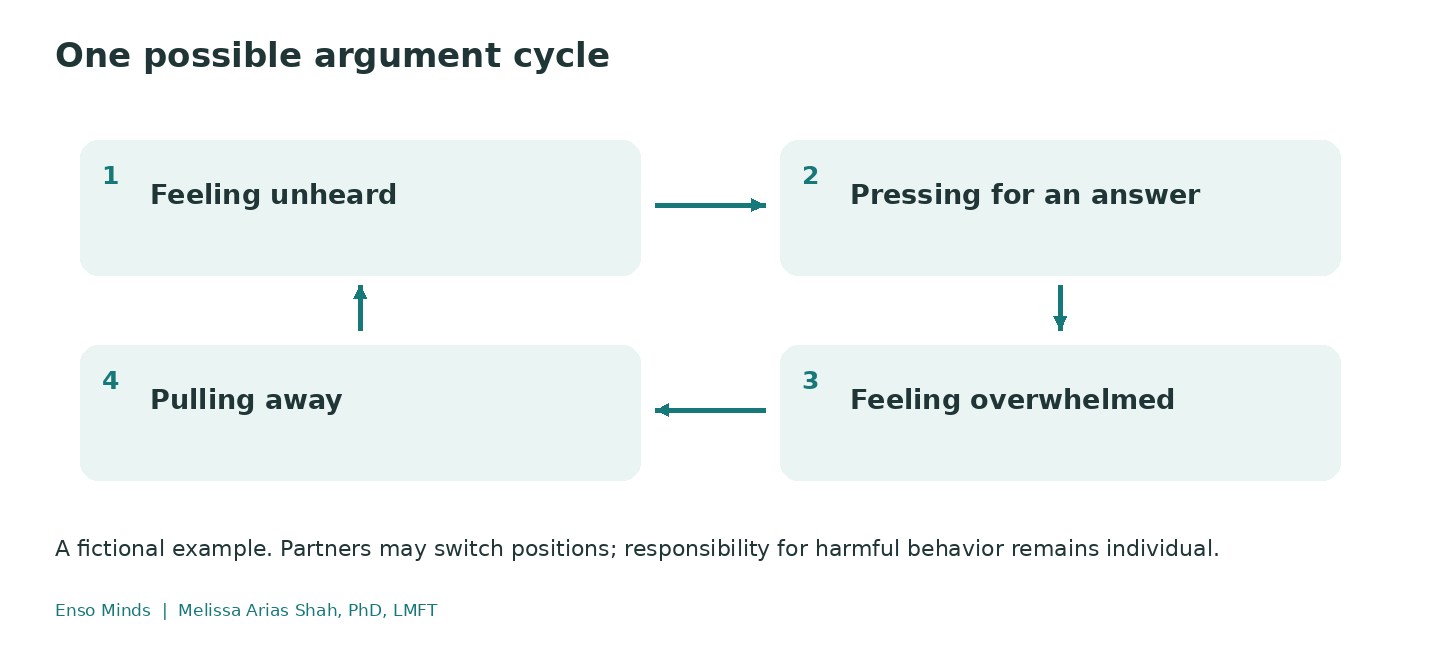
Original Enso Minds teaching graphic. A fictional example. Partners may switch positions; responsibility for harmful behavior remains individual.
Look at the conversation between you
Consider this fictional example. Alex wants to talk about feeling disconnected. Sam hears the concern as another sign of falling short and becomes quiet. Alex interprets the silence as indifference and asks more urgently for a response. Sam feels increasingly overwhelmed and leaves the room. Alex feels even less important.
Both people have an explanation for their response. Each may also miss how that response affects the other. This is one way to think relationally: examine what happens between people while remaining curious about their experiences. Relational interviewing uses provisional explanations that can be revised as people share more of their stories (Sheinberg & Brewster, 2014).
The aim is to describe the interaction clearly enough that you can recognize it while it is happening. You might say, “When I ask again and you get quieter, I become scared that we will never talk about this. Then I push harder.” That describes a sequence without claiming to know your partner’s intentions.
Identify your earliest warning sign
Choose one manageable disagreement to reflect on when you are both calm. Start with something specific: the moment your voice became louder, the moment you stopped listening, or the moment a request became a statement about someone’s character.
Ask yourself: What did I notice? What meaning did I give it? What did I do next? What could my partner have experienced in response? Your answers are starting points for conversation, not proof that you have figured the other person out.
Include the practical context. Exhaustion, financial pressure, discrimination, caregiving demands, and an unfair division of labor deserve attention. A calmer conversation still needs to address the concern that brought you to it.
Try one different response
Rather than attempting to change every part of the discussion, choose one response you can practice. You might begin with a clear request: “Could we spend ten minutes tonight deciding how to divide tomorrow’s responsibilities?” A specific time and task can make it easier to understand what is being asked.
If you need a pause, communicate it and offer a realistic return: “I want to finish this conversation. I am too worked up to listen well right now. Can we take a break and return at seven?” Agree together on what a pause means and how you will reconnect. A pause should not become a way to avoid the issue indefinitely.
If you tend to press for an immediate answer, experiment with asking one question and allowing time for a response. If you tend to withdraw, try naming your experience before leaving: “I am struggling to find words, but I am listening.” These examples are invitations to adapt, rather than scripts that fit every relationship.
Make room for repair and accountability
Repair can be small and direct: “I interrupted you. Please finish,” or “That sounded dismissive. Let me try again.” You can acknowledge your behavior without taking responsibility for everything that happened.
Understanding someone’s fear or stress does not excuse insults, intimidation, or betrayal. Each person remains accountable for their actions. Likewise, describing a repeating pattern does not establish that both people have equal power or contribute equally to harm.
If you fear retaliation, experience coercive control, or feel unsafe disagreeing, prioritize confidential individual support and safety assessment. Joint communication exercises may be inappropriate. You do not need to confront someone to demonstrate healthy communication.
When couples therapy may help
Consider seeking support when you repeatedly lose track of the original issue, avoid important topics, or struggle to rebuild connection after conflict. Therapy can provide space to explore the interaction, hear each person’s experience, and practice responses that fit your goals.
In a randomized trial of distressed married couples, both traditional and integrative behavioral couple therapy were associated with improvements, although outcomes varied and some couples later separated (Christensen et al., 2010). Research can support hope without promising a particular outcome for your relationship.
For now, choose one question: “What is one thing I could do earlier in our next difficult conversation that might help us stay engaged?” Begin there, and notice what happens.
Connect with Enso Minds
If recurring conflict is affecting your relationship, contact Enso Minds to discuss couples therapy and whether the service fits your needs. Explore couples therapy (https://ensominds.com/couples-therapy/) or contact Enso Minds (https://ensominds.com/contact/).
This article offers general education and does not replace individualized therapy or safety assessment.
References
Christensen, A., Atkins, D. C., Baucom, B., & Yi, J. (2010). Marital status and satisfaction five years following a randomized clinical trial comparing traditional versus integrative behavioral couple therapy. Journal of Consulting and Clinical Psychology, 78(2), 225–235. https://doi.org/10.1037/a0018132
Sheinberg, M., & Brewster, M. K. (2014). Thinking and working relationally: Interviewing and constructing hypotheses to create compassionate understanding. Family Process, 53(4), 618–639. https://doi.org/10.1111/famp.12081
About the author

Melissa Arias Shah, PhD, LMFT is a licensed marriage and family therapist, educator, clinical supervisor, and founder of Enso Minds. Her work emphasizes relationships, strengths, culture, and intentional change. Services are available in English and Spanish. Contact Enso Minds to discuss service fit and availability.
Explore Couples TherapyShare Dr. Arias Shah:
